Tuesday, 15 March 2016

Milk processing of pride of cows milk

Milk is one of the staple foods consumed by people all over the world. All dairy products are rich in essential nutrients. Dairy products are quite essential for a healthy balanced diet and it should be consumed by people of all age groups daily. Today there are a large number of milk processing plants possessed by dairy companies in India. The entire process begins in a dairy farm.


Now, you may ask what exactly the functions of milk processing plants are. The entire process begins in the dairy where the cows are used to obtain milk. After it is collected from the cattle, it has to be clarified and separated. It is then fortified with the essential vitamins. To reduce the amount of fat and kill bacteria, it is then homogenized and pasteurized. Once these procedures are completed, the product is packaged and sold in packets or cartons.


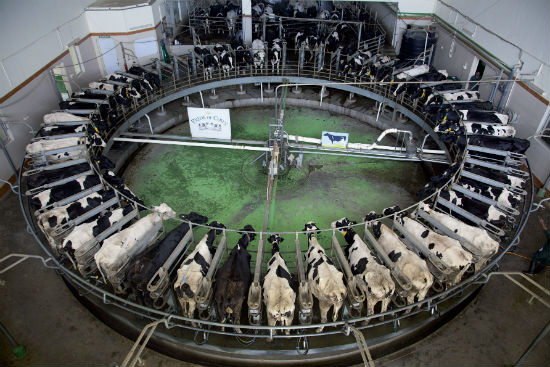
Cows are milked two times in a day in every dairy business in India. In large farms the procedure is done using vacuum equipments. It is then transferred to large refrigerated tanks. These tanks are collected by large trucks which transport the product to processing plants. Before transporting the product to the processing plants, the flavor and the temperature of the product is tested to ensure that it is suitable for use.


The truck is then transported to the processing plants. At the milk processing plant, the product is pumped into special tanks. It is then taken for separation and clarification process. In milk processing plants, the product is separated from bacteria and unwanted remains so that it is ideal for consumption. This process is known as clarification. It is spun in huge vats for some time. The initial spin separates all types of bacteria and debris from the product. It is then spun again to segregate heavy and light milk.


In the next step, the product is fortified with vitamins. Both vitamin D and Vitamin A are blended into the product in accurate amounts. With the process of fortifying the product with vitamins, it is then ready for pasteurization. The process involves heating the product to kill the remaining bacteria present in it. In the process of pasteurization, the product is heated and passed through steel pipes.
The next step involves homogenization which eliminates fat from the product. The product is heated to reduce the fat particles present in it. Without the process of homogenization, fat particles would float on top of the milk.


The final process involves packaging the product in cartons or plastic bags. They are then transported from the processing plants to different parts of the country. The products are also transported to different parts of the world. Today a variety of dairy products are transported to different parts of the country quite easily. Various dairy products like pride of cows milk can be bought from online stores too.

Friday, 11 March 2016

Maintenance of a milk processing plant

There's simply no doubt about how the dairy industry in India stands advantageous to that of countries abroad. From being a traditional and family run business in the past to an exceptionally organized vertical, India has progressed tremendously in this sector. All this has been possible because of technological specializations happening in every section of cow farming in India.
Courtesy the modern day farming equipment, milk farms across the country are able to manage several thousands of cows and buffaloes. This boost has also opened several job opportunities in the country. However, there are a number of dairy farms in India that still run the organic dairy farms in rural areas. They supply this milk to large companies. These companies have milk processing plants that process the milk and sell them to the retail outlets. In order to make your farm the best and ensure that it reaps in maximum profits you must create and run a farm that is sustainable and efficient.  

What makes cow farming in India a suitable occupation?

In India, the climate is favorable all year round and this supports proper growth and development of milk producing animals. Moreover, the basic raw materials that is needed for dairy farming is available in abundance in India. Thirdly, India is a home to large scaled skilled labor. These workers willingly accept to spend their life in the farms. The entire technological infrastructure is readily available in our country. All the major elements that are needed for a free market system are easily available in India. Lastly, the country also has companies that are taking measures for innovation and bring up products that attract the urban markets. Topp up flavoured milk is one such innovative milk product that is relished by the kids.


Growth of cow farming in India

1.       With all the green pastures and so much rural space, dairy farming in India is a logical occupation option for many people.

2.       Dairy farming is a hugely popular and financially rewarding industry in India.
3.       Many people with some form of rural or agricultural experience find solace in running a farm on an area of land that offers a lot of appeal and a superb alternative to living in the fast-paced urban areas.
4.       If you are looking at running a dairy farm, there is much to consider. You need to know how many cows you feel you'd like to milk and just how big a property you'd like to manage. There are many dairy farms that require the help of farm assistants, particularly when several hundred dairy cows are concerned.


5.       There's plenty to consider about dairy farming in India. However, if you like routine and love the thought of being away from urban society, then this occupation could be right up your alley.

Thursday, 25 February 2016

Why investors are attracted towards the best dairy farm in India

In recent years there has been an increase in the number of investments being made in dairy farms in India. Could this be a by-product of some form of fashionable trend among local investors? Not really! Investment in dairy farms is seen as an attractive option through a combination of factors such as sustainability, wealth of experienced equity managers as well as potential growth within the agriculture industry. When combined, these factors create a compelling case for investing in the dairy industry.


Many dairy farms are being run well below their optimal level of efficiency. That is not to say they are not profitable or productive, just that there is often an enormous potential for growth. Tapping into this potential through capital development is what drives investments in some of the best dairy farm in India. By streamlining performance through a combination of tightening up existing practices and expanding upon output, investors have the opportunity to see greater returns.

In order to unlock the potential to full efficiency, it is wise to invest in new equipments, refining of the supply chain process or investment in new equipment, a combination of these three factors is also a good option. What exactly a particular dairy farm needs will vary on a case by case basis, with the constant factor being the room for improvement. Of course there will be some like gowardhan dairy that are operating at close to their maximum capacity, but of course since others are not able to capitalize to best of abilities, the investors are lured to make an investment.

Another central reason why this sort of investment has proven so popular is the inherent sustainability of the industry. At its core, every industry operates on the simple premise of supply and demand; where demand facilitates supply, opportunities for investment will arise. Dairy farming has been around for centuries, and unless human beings start making dramatically different choices in their diet it will continue to be a necessary part of our existence.


Looking at things from the investor's point of view, knowing you are putting capital into an industry that will not suddenly lose its relevance is half the battle. In this sense, dairy farms make for safe investments; since overall demand is unlikely to fall away, success is entirely in how you choose to operate your farm.


Since dairy farming is such a developed industry within India, there is no shortage of experienced equity managers who can help get the most out of your investment. With an intimate knowledge of how the industry operates, these managers will be better able to determine what areas of practice are most in need of investment. Having this sort of helping hand can be invaluable in ensuring you milk greater returns from the process.

Monday, 22 February 2016

Packaging is an important element for milk farming in India

In the dairy industry, milk farming is crucial but the second most important step that dairy products manufacturers and retailers must know about is appropriate packaging of the products. The products must be packaged in a manner that they are safe to carry, identify and merchandise. As a whole, packaging is the necessary link between the manufacturer and the ultimate consumer. To ensure safe delivery, the product must undergo necessary steps such as production, safe storage, transportation, distribution and lastly the marketing of the product. Unless the products have been delivered to the customer in a safe, sound and fresh form, the consumer is likely to reject it. This may result in huge amount of wastage. Companies or the manufacturers must take into account factors such as natural hazards and climatic changes that affect the durability of the containers during the packaging and transportation of the milk or its products.


Essential packaging requirements required to be fulfilled by dairy products manufacturers

1.       Packaging is necessary to accentuate the shelf life of the milk and its products. For the food industry, packaging happens to be the shield that prevents the contamination of the food from bacteria or any other undesirable substance such as light or moisture. Packaging is also necessary for successful storage and distribution.

2.       When you select the packaging, it must protect and preserve the milk products from the time it is packaged to the time it is consumed.

3.       It also plays a vital role in increasing the sales and catering to the distribution pattern of the products. 

4.       Your packaging says a lot about you as a company, so it definitely must be attractive to appeal to customers.

5.       It should be easy to open, use, store and dispose.

6.       Packaging chosen by you must facilitate the handling, storage as well as the distribution of the milk products.

7.       It should be sturdy enough to protect the product from the biological, chemical as well as the distribution damages.

8.       Informative enough to let the consumer know about the product via. the medium of labeling.

9.       Must act as an advertising and marketing tool.

10.   Must be economical enough.

Functions of a good packaging material for 


1.       The packaging of milk or milk products must be capable of serving 3 basic functions i.e. containing the product, protecting it and lastly merchandizing of the product.
2.       Containing means that the package or the container that you use must be large enough to hold the product in it.
3.       Protecting means that the package must protect the product from contamination, loss or damage.

4.       Merchandizing means that the shape of the container should be favorable for reuse or disposal. 

Wednesday, 17 February 2016

How do popular brands carry out dairy farming in India

Dairy farming is a strenuous and demanding job, but it is rewarding. There are a number of people here who are involved in dairy farming in India. So, competition of course is massive. But if you wish to begin with dairy farming you need to have the requisite understanding of business skills, technology and the desired educational preparation. You will find that today's farmers attend training programs at university to learn about business and practice of agriculture. The daily life of a dairy farmer involves a large amount of hard work and the day starts early and ends late working both inside and outside. They have strong work ethics and are aware of the time and the hard work their profession demands.


The profession of dairy farming involves more than just milking the cows. A farmer usually starts his day early in the morning with herding of the cattle to its milking shed. Thereafter, the farmer gives the cow some milk to drink while he himself prepares a shed for milking. After that the cows are given feed and the milking begins. If it is a wet and stormy day everything is given special attention as the cows need adequate shelter, farmers will often move their stock to a paddock with surrounding hedges offering shelter from the elements. The baby calves are given grain and milk. Cleaning the milking shed concludes the milking session. After this the heifers and dry cows are fed a special diet. Measurements of the food for the dairy cows are then done for the evening feeding and the feeding for the next morning. It is important to make sure the weight and measurements are correct so that excellent production is unhampered. This is often done twice a day in most of the dairy farms in India.


During the different seasons of the year the farmer has different priorities and jobs to focus on. In the spring time cows produce the most amount of milk and farmers milk their cows twice a day. Mating also occurs during this season. During summer time, farmers plant crops like turnip and maize. Summertime is a slower period of the year as cows produce less milk due to the conditions of the weather. Hay making begins and cows graze the summer crops that were planted to help them through the dry season. Autumn brings a conclusion to the milking and it gives the dairy farmer an opportunity to work on the maintenance or development of the land. Farmers also began preparing for the next season in autumn and winters. This is the basic outline of how a dairy industry in India operates.